



























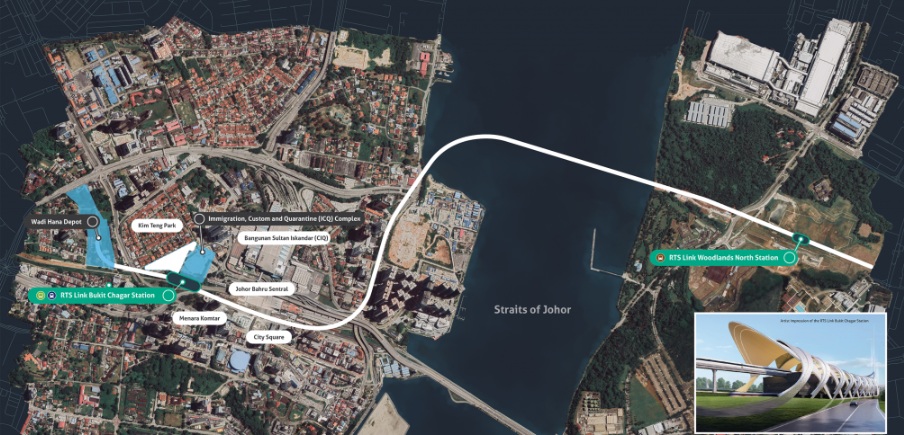
(Singapore, 18.08.2026)Passengers using the Johor Bahru-Singapore Rapid Transit System (RTS) Link will be able to connect directly to KTM trains, buses and taxis from Bukit Chagar station, as Malaysia prepares the surrounding transport network for an expected surge in cross-border commuters when the rail service begins operations in early 2027.
Malaysia Transport Minister Anthony Loke said a new pedestrian connection will be built between the RTS station and the nearby Keretapi Tanah Melayu (KTM) station at JB Sentral, allowing passengers to transfer more easily to KTM Komuter services serving other parts of Johor and the Electric Train Service (ETS) to cities including Kuala Lumpur and Ipoh.
The new connection will branch off from a covered pedestrian bridge linking Bukit Chagar station with JB Sentral, allowing KTM passengers to reach the RTS without first walking through JB Sentral and then doubling back towards the cross-border rail station. The Malaysian government will spend RM60 million (S$18.89 million) on the additional link, which is expected to take about 12 months to complete.
The wider pedestrian bridge, which is equipped with travellators and designed to handle thousands of passengers at a time, forms part of Malaysia’s efforts to disperse crowds around Bukit Chagar as passenger numbers increase. RTS users will also have access to buses from a designated roundabout along Jalan Jim Quee, as well as a taxi bay further along the road.
Connections to buses, taxis, JB Sentral and the nearby Komtar JBCC shopping mall are expected to be ready when the RTS begins operations, while Loke said the aim is to integrate Bukit Chagar with multiple modes of public transport and prevent congestion from simply shifting from the Causeway to central Johor Bahru.
e-ART Plans Still Being Worked Out
One piece of Johor Bahru’s wider transport plan, however, will not be ready in time for the RTS opening. The proposed elevated Autonomous Rapid Transit (e-ART) system, intended to absorb some of the additional passenger movements generated by the cross-border railway, remains under development.
Loke said the government is still working out the concession agreement for the project and will provide further details when it is ready, although he confirmed that the system will eventually be integrated with the RTS Link.
The e-ART is expected to operate as an autonomous train-bus hybrid using rubber-wheeled carriages and sensors to follow routes defined by virtual tracks. Johor Chief Minister Onn Hafiz Ghazi has repeatedly called on the federal government to accelerate the project, arguing that measures such as park-and-ride facilities and reorganising buses, taxis and ride-hailing vehicles around JB Sentral can only provide interim solutions.
The need for stronger public transport connections has become more pressing as the RTS moves closer to completion. The 4km railway between Bukit Chagar and Woodlands North in Singapore will carry up to 10,000 passengers an hour in each direction, with daily ridership projected at around 40,000 once services begin.
Malaysian authorities are targeting a journey of no more than 25 minutes from the time passengers enter Bukit Chagar station until they board the train, including ticketing, security screening and immigration clearance for both Malaysia and Singapore. The train ride across the border itself will take about five minutes.
Bukit Chagar station will have 18 luggage scanners and nine body scanners using millimetre-wave technology and artificial intelligence to detect concealed objects, while electronic immigration gates will allow passengers using Malaysia’s MyNIISe app to complete immigration clearance in as little as seven seconds.
Passengers will clear both Malaysian and Singapore immigration before boarding, removing the need to undergo another immigration process after arriving at Woodlands North.
Fare Decision Expected Later
The physical infrastructure at Bukit Chagar, including its customs, immigration and quarantine facilities, is essentially complete, according to Loke, with the project now entering the final testing and commissioning stage ahead of operations.
The RTS completed its first test run in December 2025, and experts have estimated that the service could reduce traffic congestion at the land checkpoints by as much as 25 per cent, offering commuters an alternative to travelling between Singapore and Johor Bahru by car, bus or motorcycle.
One major question still to be settled is the fare. Loke said Malaysia and Singapore are continuing discussions and will jointly announce ticket prices and the official opening date at a later stage.
RTS Operations, the joint venture between Malaysia’s Prasarana Malaysia and Singapore’s SMRT Corporation, was expected to submit its pricing proposal to regulators in both countries during the third quarter. Loke previously indicated that a one-way journey could cost around S$5 to S$7, while stressing that the final operating model must be commercially sustainable.
The RTS is also expected to reshape travel and consumer flows on both sides of the Causeway. A recent study commissioned by Singapore business groups estimated that Singapore residents could spend an additional S$1.05 billion a year in Johor Bahru after the service opens, while additional spending by Johor Bahru residents in Singapore was projected at S$756 million annually.
Malaysia is meanwhile continuing preparations around Bukit Chagar to handle those passenger flows, with the new KTM connection joining planned bus, taxi, shopping mall and other transport links as Johor Bahru builds a broader interchange around the cross-border railway.