

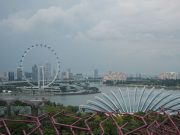




















(SINGAPORE 2026.6.2) As investment flows shift toward East Asia and geopolitical blocs become hardened, Singapore is emerging as a leading hub for AI capital. Yet the city-state embodies a striking duality: while its geopolitical neutrality and access to international markets make it an ideal base for global expansion, its conservative investment culture and relatively subdued innovation environment limits its entrepreneurial dynamism, Chinese media noted.

In practice, Singapore functions less as a birthplace of frontier AI breakthroughs and more as an interface city—where capital, founders, multinational firms, and institutions intersect. It is a launchpad for regional and global scaling rather than a deep-tech gravity center that generates technological paradigms.
In October 2025, Singapore’s Infocomm Media Development Authority (IMDA) released the Singapore Digital Economy Report 2025, which found that AI adoption among SMEs stood at just 14.5%. The figure highlights a substantial opportunity for startups. But the implication is clear: Singapore’s AI growth story is not about building foundation models; it is about deploying existing AI systems into real-world business environments.
As AI enters what many observers call a “deployment phase,” the country’s role becomes more defined. It is more a testing ground for applied AI in logistics, finance, retail, and enterprise software. Chinese think tank and media platform Global Insights (霞光社) noted that this shift suits Singapore.
Today, Singapore is widely branded as the “Silicon Valley of Asia,” attracting AI founders from China, the US, and elsewhere. But beneath this label, the ecosystem is uneven. Chinese entrepreneurs broadly fall into two archetypes, Global Insights pointed out.
The first group consists of younger founders, often from local universities or recent graduates. They are experimental, loosely networked, and build early-stage products based on campus ideas. Their startups are small, exploratory, and still searching for product-market fit.
The second group consists of experienced operators—former executives or founders from major Chinese tech firms. Many have already raised capital in China, built scaled products, or managed mature operations. For them, Singapore is not a starting point but a strategic node.
Zhou Yu (周屿), a Chinese graduate in Singapore interviewed by Global Insights, belongs to the first category. She described the startup environment of Singapore as relatively “boring.” Technical density is moderate, investors are conservative, and startup culture lacks intensity compared with China.
By contrast, she sees China as continuously producing high-velocity experimentation, while the Middle East is positioning itself as a potential “third pole” in AI through sovereign capital. Given these dynamics, she feels compelled to explore beyond Singapore.
For the second group, however, Singapore offers a different value proposition: stability, regulatory clarity, and global connectivity that allow prior experience to be leveraged more effectively.
This divergence is reinforced by shifts in China’s venture capital landscape. Investors there favor “AI-native” founders born in the mid-1990s and 2000s, while founders born before 1985 are often seen as “outdated” in fundraising discussions, according to Global Insights.
Ellen, a former China-based US dollar fund investor who moved to Singapore in 2023, offered another perspective. Through her podcast Offline Time (离线时间), she speaks with AI founders who have relocated there. She argues that in the AI era, long-horizon capabilities—product intuition, market judgment, and risk awareness—are becoming more important than raw technical novelty.
These capabilities, she said, are accumulated over 10–20 years. “They are the rarest assets,” she noted, “and they form the foundation of a founder’s confidence.” From this view, experienced founders remain highly competitive.
Singapore’s rising role is also reflected in capital flows. In 2025, Asian billionaires injected about S$77 billion into the country, driven by geopolitical tensions, asset safety concerns, and global market fragmentation. Singapore’s neutrality, legal stability, and tax efficiency have made it a preferred destination for wealth preservation and global structuring.
In the same period, China overtook the US as Singapore’s largest source of fixed asset investment, accounting for 20.6% of inflows versus 17.3% from US firms—a sharp reversal from 2024, when US firms dominated.
As one investor put it, half-jokingly, “the end of the universe is Singapore,” reflecting how capital converges there during this time of uncertainty.
Ellen is part of this wave. After the pandemic, she observed a surge of heterogeneous startups in Singapore spanning fintech, robotics, consumer tech, and cross-border commerce. Over time, however, the focus consolidated around AI, particularly large-model applications.
She described Singapore’s regulatory stance as basically neutral. The government does not care about a company’s nationality but examines its incorporation structure, ownership concentration, and whether it is globally oriented.
“As long as it’s a Singapore entity serving global customers, it is treated as international,” she explained. However, she noted there is an informal expectation that teams should not be overly homogeneous in nationality.
A key advantage, she stressed, is geopolitical neutrality. In a fragmented global system, the ability to avoid alignment with major blocs becomes Singapore’s strategic asset.
Another advantage is scale. Singapore’s compact land size creates dense social and professional networks where information circulates rapidly and access to decision-makers is relatively flat.
In a city-state smaller than one-ninth of Shanghai, global tech giants such as Google, Meta, IBM, Microsoft, Amazon, and TikTok operate side by side, producing a tightly interconnected ecosystem.
Ellen described this vividly: “You keep seeing the same people at events. The person across from you might be from OpenAI. You get first-hand information here. In China, you often get it second-hand.”
This reduction in information asymmetry lowers the barrier to entrepreneurship and mirrors AI’s core logic: accelerating information flow and reducing cognitive distance.
This environment produces highly pragmatic startups. One example is a small AI-enabled food supply chain company informally described as an “AI egg trading business.” With a team of five, it digitized procurement via WhatsApp, optimized logistics, served nearly 2,000 restaurants, secured import licences, and generated millions in revenue within a year, later expanding into other commodities.
This reflects Singapore’s dominant startup pattern: narrow scope, operational efficiency, and real-world execution over platforms.
This aligns with a broader global shift. According to the UK’s Financial Times, the next wave of AI value creation will come not from foundation models but from “last-mile deployment”—embedding AI into specific industries. The Asia-Pacific region is expected to become a major battleground for this phase.
The regional AI market is projected to grow from US$102.5 billion in 2025 to over US$816 billion by 2032, driven primarily by adoptions in logistics, manufacturing, retail, and services.
However, Singapore’s pragmatism could put a ceiling on ambitions. Venture capital remains small and conservative. Ellen noted that many local funds have underperformed, with DPI (distributed to paid-in capital) often below 1 and many returning only 0.6x to LPs (limited partners). Even stronger vintages rarely exceed 1.5x, shaping cautious behavior and capped valuations, often below US$30 million post-money.
Her conclusion is clear: Singapore is an operational testbed, not a capital engine. It is ideal for incorporation and regional expansion, but not for high-growth funding. Most successful founders rely on China-based or global capital.
Zhou Yu agreed, noting that Singapore’s VC ecosystem favors later-stage deals and remains risk-averse.
At the product level, this environment creates a subtler cost: reduced urgency. Compared with China’s high-pressure startup culture, Singapore generates less FOMO-driven i0teration. In fast-moving sectors like AI, slower execution can mean missed opportunities.
Government policy also shapes the ecosystem. Many support schemes require 30%–51% local ownership, limiting access for foreign founders, even though full incorporation is possible under provisions like EntrePass.
Talent is another bottleneck. Startup operators who can bridge China and global markets are scarce, while many locals prefer stable careers like finance. Besides, Singaporeans are well-sheltered by the government. Even well-funded startups can take months to hire key roles.
High costs further constrain operations. CBD office rents have risen roughly 30% over eight quarters and are significantly higher than comparable districts in Shanghai or Shenzhen, pushing startups toward lean structures.
These constraints shape entrepreneurial trajectories. Zhou Yu plans to leave for Shanghai’s Zhangjiang district (张江区), citing stronger technical density and more active founder networks there. In her view, Singapore will remain a key node but not a permanent base. Entrepreneurship is increasingly global and mobile.
In its strengthening model, Singapore functions as an offshore headquarters and coordination hub within a distributed innovation network—used for organization and access, while other regions provide intense capital or deep technologies.
Ultimately, Singapore may not be large enough to contain the full scale of global AI ambition. Yet precisely because of its neutrality, compactness, and efficiency, it remains one of the most strategically useful starting points in the global AI map, concluded Global Insights.